
 Following my introduction to Shaw at the Kanye concert in Oakland, I decided to look more into her music once I fell in love with her beautiful rendition of Kanye’s “Only One.” I came across a piece by her that is as challenging as the many projects and ideas Kanye has taken on himself.
8 voices. 1 beautiful piece. There is no word other than “mesmeric” that can better describe Caroline Shaw’s “Allemande” from Partita for 8 voices. The many harmonious layers in the sound, the left and right movement of the voice when wearing headphones, along with the persistent drone-like voice in certain parts of the piece come together to form a piece that is mesmerizing to a listener. For me, the initial strangeness, a deviation from music I am normally acquainted with, lured me in to better understand the piece. Shaw’s “Allemande” stretches the limits of the human voice, utilizing it as a tool, stretching and shaping it to create sounds more beautiful than those of instruments.
Allemande is a French word for “German dance”, which was popular during the Renaissance and Baroque periods. The piece itself seems to aim at creating a scene of an allemande dance. The song opens with phrases such as “to the side” and “through the middle” being repeated, with the sound being layered one on top of another. The words create a sense of instruction yet chaos; Shaw is guiding the dancer on how to move within the dance but there seems to be no coherence amongst the individual dancers. Finally, we see a sudden shift with a voice that starts an eight count. It is at this moment, that the phrases become more complex and the sound becomes powerful. The voices sing “through the midpoint” and “of the line drawn”, which are much more descriptive in nature. The voices rise in unison to the rising level of instruction and now a harmony is found. The voices come together in a mesmerizing climax of the voice; it’s much easier and almost inevitable to having a visualization of individual dancers moving in unison within the patterns of a square. The combination of the voices and the word painting as a result from it, help to highlight Shaw’s ability in painting a vivid scene with nothing more than eight human voices.
Following the loud and powerful part, the voices once again give more detailed phrases like “ a square divided horizontally and diagonally.” Once again all the voices and the individual dancers come together in unison in a beautiful layering of voices. After this, the voices are still in unison but lose power. The sound begins to sound divine like, almost out of this world. It’s as if you can quite literally hear the singer change his mouth from an “ahhh” to a more “ohhh” sound. At around 1:45, this is when the phrase “The detail of the pattern is movement” is repeated numerous times and this helps to give insight into the meaning of the piece as a whole. I believe Shaw is attempting to suggest the beauty in the voices and the dance in unison. With a background drone like sound persisting for a while, ultimately stopping and then picking back up again, it’s as if the dancers are coming to a rest, and finally to a complete rest when the drone disappears. “The detail of the pattern is movement” is used to show how even when the dancers have come to almost a “freeze”, the overall image of the dancers is still one full of movement. The dancer, who were dancing in a rectangle-like shape, as the voice instructed, must have frozen in that shape as well, thus showing movement through the lines and shapes they create. The movement of the piece and the voice of the singers come together in unison to create a surreal visualization. The voice and visuals seem to be able to find a way to combine stillness and movement.
Following this, we hear a similar union of the voices but the more drastic change occurs around the 3:28 mark. The tone and mood of the piece seem to have changed and the rhythm has changed to a slower persistent sound. Whereas in the beginning there was a consistent layering of the voices, now there seems to only be persistent male drone voice in the background with female voices dominating in the foreground. The phrase that is repeated is “round and around” and it seems that the voices have once again found a union that is different than the previous one. The first one was a powerful energy driven one, yet this one is a more surreal and calm union. It’s the beautiful climax of the piece, with everything falling into place before the close.
The conclusion is a persistent drone-like, very low-level noise, which comes after a complete pause for air. The voices seem to be tired and failing; Shaw has stretched and manipulated the human voice beyond the limits we are normally used to. Visually, I see it as the dancers once again coming to a stop, the dance is over and the image I see is a slow descent of the dancers to the ground. The sudden breath of air near the end is the moment at which the dancers have come to a complete rest, with the very short drone sound that follows symbolizing that while the dance has ended, it is nonetheless still beautiful.
While strange to listen through for the first time, the piece definitely has certain parts of it that are reminiscent of pieces I have heard in my Music 27 class I’m currently enrolled in. One of the first comparisons I found is to the medieval chants I listened to. The ending of Shaw’s piece, with the divine and drawn out notes, along with the drone like sounds, sound very similar to the sounds in “In Paridisum.” Both pieces sound very holy and divine with lots of drawn out notes and are used in order to show the harmony and beauty in the human voice. They are both very smooth and have a spiritual quality—passionate yet serene. The song also has qualities from “Rector Potens, Veras Deum”, where there are multiple voices singing together, yet we are surprised near the end where even more voices come together in unison to create a powerful sound.
In my discussion section for Music 27, I learned about Robert Schumann’s “Carnaval”, which brought together 21 different “characters” in order to speak about gender issues. In the same way, Shaw seems to have brought together 8 voices in order to paint a scene. Both pieces use more than one voice to help paint the scene or develop a theme. What’s interesting about both of them is that they leave a lot of the interpretation to the listener. While I may have this interpretation of the piece, another listener may see Shaw’s piece as meaning something completely different. The same goes for “Carnaval.”
However, one of the biggest differences is the style of the piece as a whole. There aren’t concrete lyrics that tell a story; instead, it’s more high level and artistic. If one were to read some of the lyric sheets for other pieces I listened to in my music class, they might get a good idea of what the piece is about but with Shaw’s “Allemande”, it’s almost impossible to understand without hearing the eight voices. Another style that is new is the break from tradition. A lot of the pieces I listened to in my class seemed to be “safe” and didn’t challenge drastically the conventions of the time. Whereas, Shaw’s piece does exactly that.
This song stuck out to me in a strange way. I normally would have never even considered listening to Shaw’s music, had I not gone to the Kanye concert and see her beautifully perform one of my favorite Kanye songs. Shaw has shown that in an era where we’re so accustomed to loving songs for the beat and rhythm they have, we’re missing what makes a song beautiful: the voice. Shaw forces the human voice to its limit in a way that is new to people. It certainly is provocative and not something that everyone may enjoy; yet for those who have even the slightest interest in music, it speaks levels about the role of voice in music. It’s different. It’s strange. It’s unique. Yet, it’s powerful. Shaw’s “Allemande” uses musical techniques, such as layers and repetitions, to allow the voice to paint pictures and create the mood. While chaotic at first, the voice and the movement of the dance come together as one by the end of the piece, creating a beautiful and mesmeric piece.
 Contrary to the numerous other shows in his tour, Kanye seems to have deviated from what is normal at his shows and for the first time, he brought out a supporting artist at his show. The singer, known as Caroline Shaw,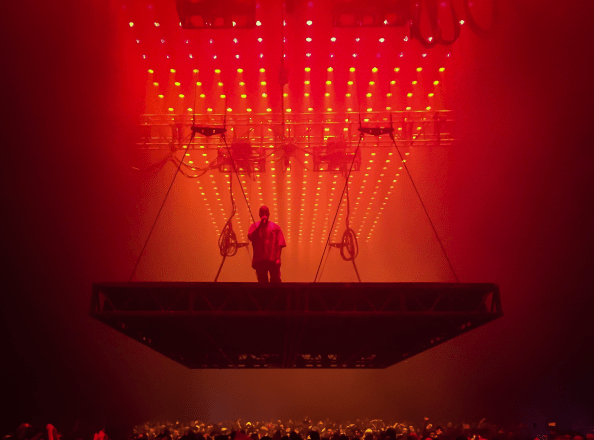

 “Blood on the Leaves” is more than just another song by an artist. The song is a daring social commentary about slavery, society, relationships and death. The song features a sample of “Strange Fruit” by Nina Simone.
 No title of any song in all off Kanye’s discography better sums up the overall mood of not only the album to which it belongs but also the time feelings Kanye had when composing the album, “Welcome to Heartbreak” is a song of self-realization, one that reflects on Kanye’s past and future; it’s a realization that fame isn’t what he painted it out to be when he was still a rising star.
 “Bittersweet Poetry” is one of Kanye’s most underrated songs, as it failed to receive the exposure it deserves since the track was a Japan exclusive for the album Graduation. This song features a hook by Joh Mayer. The main theme of the song is about an ex-lover that Kanye has dubbed as “Bittersweet”. This word is commonly associated with food that exhibits both properties of sweet and bitterness. The hook describes how Kanye proclaims to his lover that he “doesn’t want you, but I need you”, which is indicative of a struggle he has with letting go.
 In his song, “All Falls Down”, Kanye addresses an issue that almost every individual faces, but is too scared or nervous to openly admit: being self-conscious. The song opens with a prolog in which Kanye states that this is “the real one” since he sampled Lauren Hill’s track “Mystery in Iniquity” for the hook of the song (whosampled.com).
  Musical Analysis